
Understanding Your Drug and Alcohol Treatment Options
If you or a loved one is struggling with drug or alcohol use, we understand that deciding whether or not to get treatment, and what kind of treatment you need, can feel daunting. It can also be confusing to know where to start, depending on what is going on for you or your loved one’s use. We’ve created this article to provide you with clarification about the various levels of treatment available. For the remainder of this article, we will write as though we’re speaking to the person who may need treatment for their drug or alcohol use, but everything applies if you are a loved one searching for support for someone you love.
Discovery – A Great Place to Start
At Kagey Family Counseling, we believe that the very first step in addressing issues you may have with drugs and alcohol is Discovery. During Discovery, you may reach out to us because you’re curious as to whether or not you have an issue with your use. We consider this to be an often overlooked, but vitally important stage of exploration. Just because you’re struggling with substances or find yourself using more often than you’d like, doesn’t necessarily mean you’re an alcoholic or addict. Substance use exists along a continuum that goes from casual use to abuse to addiction. We recognize this and start working with you where you’re at.
During the Discovery phase, we support and guide you while you try some controlled drinking or using and help you understand your options during this phase. Our goal is to provide you with honest and educated feedback about how your use is impacting your health, relationships, work, family, and your overall life. Ultimately, you’re the only one who can decide if or when your use has become a problem, and we think it’s important to do that while you have professional support. This work is typically done in outpatient, one-on-one counseling.
The Different Levels of Care – Starting with Outpatient Counseling
The graphic below demonstrates the levels of care available for drug and alcohol treatment. They are listed in steps to demonstrate the increase in time per week and cost per week that accompanies each level of care.
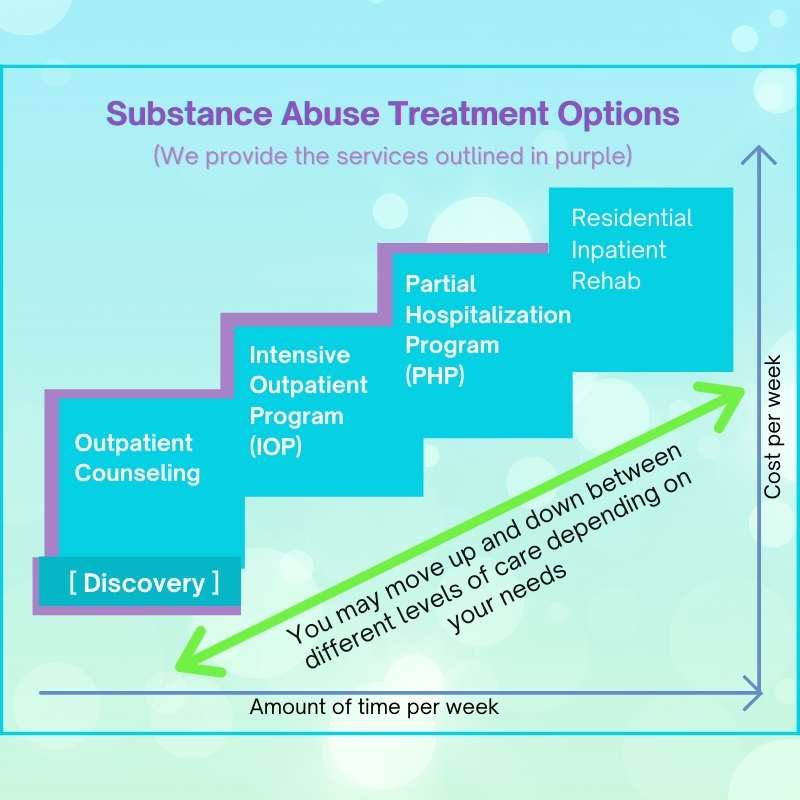
As you can see, Outpatient Counseling is usually considered the “lowest” level of care. This only means that this level of care usually requires you to spend the least amount of time and money per week in treatment. However, it does not mean that it’s a less important or necessary level of care; it just means that your treatment needs can be met in this setting. Typically, Outpatient Counseling is one-on-one counseling and/or family or group counseling that you go to about once or twice a week. This where the Discovery phase typically happens too. The benefits of Outpatient Counseling are many and are specific to the “why” of what led you to seek help and to the particular type of support you need.
Here are the different kinds of Outpatient Counseling we offer (not including group counseling):

Moving Up the Levels – IOP and Its Benefits
The next level of care is an Intensive Outpatient Program, often referred to as IOP.
IOP is covered by many insurance providers and is done while you are living at your residence and continuing with your daily activities, work, and/or family duties. The benefits of IOP include:
- Provides an intense, short-term program with a high level of care and education
- Helps you build a recovery community & support system where you live
- Is flexible enough to do while maintaining your job, school, & family duties
- Helps reduce risk for relapse and effectively manage a recurrence of symptoms
Again, as you can see from the Substance Abuse Treatment Options graphic, IOP requires more time per week and costs more than Outpatient Counseling.
PHP and Its Benefits
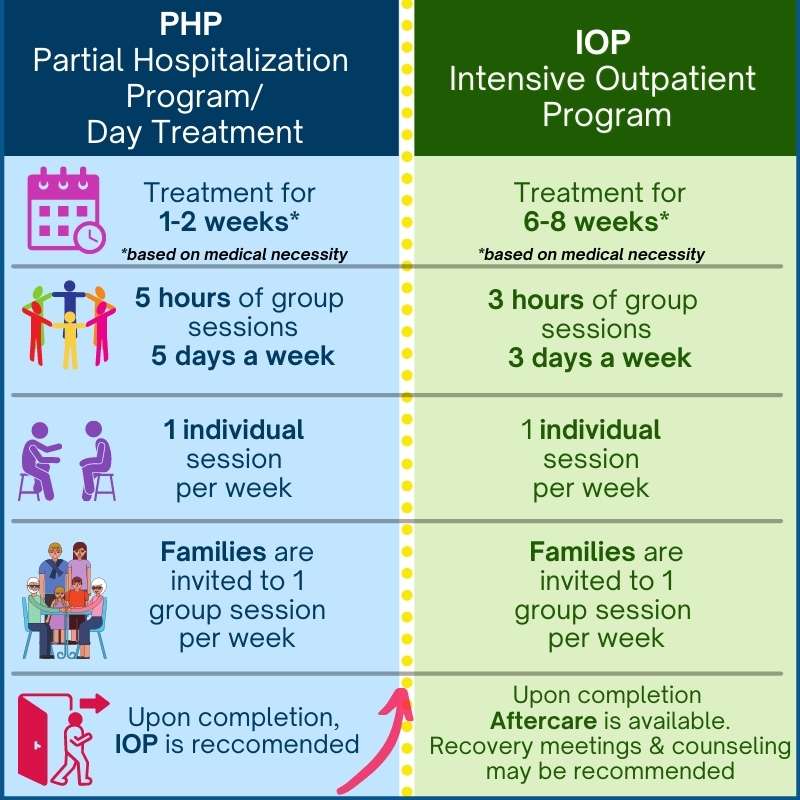
A Partial Hospitalization Program or PHP is the level of care. The name of this treatment option can be confusing because it sounds like it’s a program during which you are ‘hospitalized’. However, this is not the case. Much like the IOP level of care, during treatment in PHP, you reside at your personal residence while you are in PHP treatment. We often refer to it as Day Treatment so as to make this more clear. The difference between PHP and IOP is that you spend more time per week in treatment in the Partial Hospitalization Program. It is also more costly, but again, many insurance plans cover this level of care too.
People who may benefit from PHP are those who need a highly structured program and who are able to spend the majority of their weekdays in treatment. Unlike IOP, PHP is usually more brief in duration, lasting about two weeks as opposed to IOP, which is typically for six weeks. It’s important to note that the length of time you spend at either of these levels of care is based on medical necessity and determined by your treatment team.
The benefits of PHP are:
- Provides a smooth transition for you from residential to outpatient treatment
- Offers you a high level of structure, support, and accountability
- Is flexible enough to live at home while getting a high level of treatment
- Helps you if you have relapsed and want to get back on track
To better understand the similarities and differences between IOP and PHP, the following graphic is a side-by-side comparison of what each program offers.
We Have PHP and IOP Programs
In addition to the Outpatient Counseling services we offer at Kagey Family Counseling, we also have a Positive Recovery Center PHP and IOP treatment program located in the Energy Corridor of Houston. Both our programs are covered by many insurance programs and are based on the P.E.R.M.A approach to substance abuse recovery. P.E.R.M.A. stands for Positive (Emotion); Engagement; (Positive) Relationships; Meaning; and Achievement/Accomplishment.
The P.E.R.M.A approach is an evidence-based addiction curriculum that integrates existing effective approaches to treatment with interventions that enhance well-being. In other words, our approach is based on the theory that addiction develops when happiness is pursued ineffectively and recovery is when people pursue happiness in a healthy way. Rather than shaming or blaming you for your addiction, we focus on the positive aspects of your life and recover and we help you identify your strengths and build upon them. We do this by:
- Helping you to better understand your substance use
- Equipping you with the tools you need live a sober life
- Helping you connect with others facing similar challenges
- Providing you with resources to connect with sober communities where you live
Residential/Inpatient Treatment
The highest level of care in terms of length of treatment per week and cost per week is residential/inpatient treatment. Residential/inpatient care is often referred to as “rehab” and typically lasts at least 30 days. You are likely familiar with this level of care since many movies have been made that feature it, and when most people talk about “going to treatment” for alcohol and drugs, they are referring to this level of care.
As its name suggests, you actually live full-time at the treatment facility when you’re in residential/inpatient care, and you receive 24-hour care, seven days a week. Typically, these programs also include medical detox components and offer a variety of integrated mental health services. Going to rehab is a big commitment for most people as it requires you to leave your daily life for an extended period of time. However, you may need this level of care if you haven’t been able to get sober in an outpatient setting or if there are other circumstances that make residential care the best option for you.
How We Serve You – A Personalized Bridge Before and After Residential Care
While we do not offer residential/inpatient care, all of the levels of care we do offer can serve as a bridge on either side of your rehab experience. For instance, if you are in rehab and are looking for treatment options once you return home, we will set up a personal session with you online or by phone to get the best understanding of you and your treatment needs. We also offer to collaborate with your rehab treatment team to coordinate your care transition as seamlessly as possible. This holds true whether you are going from our outpatient care services to rehab or coming from rehab to our outpatient care setting. We believe that actively participating in your treatment planning, coordinating with your residential team, and communicating with your family significantly increases the chances of success for your recovery.
There is Hope and Help
Overall, the most important thing to understand about the variety of treatment options available is that you have many choices. Depending on what you need, and as your needs change, you can move up and down the different levels of care. If you are in treatment with us, we will continually review your needs and support you in making the best choices for you and your recovery.
If you’ve been considering getting help for your alcohol and/or drug use, you can start with one powerful act by asking for help. It is up to you to make a decision and reach out. We urge you to search your heart and soul and decide if you’re ready to discover what’s really going on with your use.
If you’re ready to get started, we invite you to call our office at 832-928-0211 for a free 15-minute phone consultation. We’re happy to discuss your specific needs and answer any questions you have. We have offices in Houston, TX, and we provide online therapy and recovery coaching for anyone living outside the Houston area.